

How Pack Stations Are Reshaping End‑of‑Line Packaging
In many different types of businesses, packaging is treated as a finishing step, something that happens after the “real work” is done. Products are made, quality‑checked, and ready to ship, only to slow to a crawl at the very end of the process. What should be a smooth exit often turns into a bottleneck.
That slowdown is rarely caused by a single failure. More often, it’s the result of small inefficiencies piling up: manual box forming, inconsistent labeling, uneven pacing between operations, or labor shortages that make staffing predictable shifts difficult. When packaging depends too heavily on manual effort, even short delays ripple backward through the entire line.
As manufacturers look for ways to do more with less, end‑of‑line packaging has become one of the most practical places to apply automation.
The Case for Automating Packaging
Across the U.S., companies are investing more in packaging automation, but not always by jumping straight to fully robotic lines. Many operations still rely on hybrid setups that blend automation with human oversight, especially at the case‑packing and shipping stage.
This is where Pack Stations fit naturally. Rather than replacing the entire line, a Pack Station improves the moment when finished products become finished shipments. It brings structure, flow, and consistency to packaging tasks that are otherwise repetitive and labor‑intensive.
How Pack Stations Change the Flow of Work
In a manual packaging setup, operators often juggle many tasks at once. One person is forming boxes while another waits for product. Boxes stack up, labels get applied off‑line and small interruptions snowball into downtime.
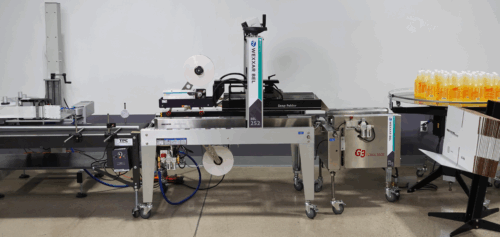
A Pack Station redefines that experience by creating a dedicated, integrated workspace where each packaging step supports the next. Products arrive at a controlled pace. Boxes are formed automatically. Sealing and identification happen inline, without unnecessary handling or rework.
What Goes Into a Modern Pack Station?
While no two Pack Stations are identical, most are built around the same core idea: keep products moving steadily and reduce unnecessary motion.
Conveyors and accumulation tables help regulate flow, so operators aren’t rushed one moment and waiting the next. Automated case formers take over the time‑consuming task of erecting boxes, adjusting easily for different sizes. Case sealers apply tape or adhesive with uniform pressure, removing guesswork from a critical step.
Identification is handled inline as well, either through automated labeling or direct case printing. This not only improves traceability but also eliminates the extra handling and errors that come with off‑line labeling.
When needed, additional protection like shrink wrapping can be added without disrupting the layout.
Because these components are modular, Pack Stations can evolve with the operation instead of becoming obsolete as volumes change.
Automation That Supports People
One of the most overlooked benefits of Pack Stations is ergonomics. Manual packaging often involves awkward reaches, repetitive motions, and lifting that wears down operators over time. Those stresses contribute to injuries, fatigue and turnover.
Pack Stations are designed around the operator. Tasks happen at consistent heights. Movements are reduced or assisted. Repetitive actions are handled by machines, allowing employees to focus on monitoring quality and keeping the line running smoothly.
In one recent time study, implementing a Pack Station increased packing speed by 82%, raising output from 2.7 to 4.9 boxes per minute, without adding headcount. Gains like that matter, especially when labor is hard to find and even harder to retain.
A Practical Path to ROI
Unlike large‑scale automation projects that require massive upfront investment, Pack Stations offer a more approachable entry point. Because they’re modular, manufacturers can automate the areas that cause the most friction first, then expand as demand grows.
Many facilities see returns quickly through higher throughput, reduced labor dependency, and fewer packaging errors. Just as importantly, Pack Stations help create a more stable process that’s less vulnerable to staffing challenges or minor disruptions.
Automation doesn’t have to be all or nothing. In packaging, incremental improvements can deliver the biggest wins.
Where Pack Stations Make the Biggest Impact
Pack Stations are especially effective in environments where speed, accuracy, and flexibility matter:
- Contract packaging
- E‑commerce
- Food and beverage
- Manufacturing and assembly
- Shipping and receiving
In each case, the goal is the same: move products out the door efficiently without sacrificing quality or safety.
Turning Packaging Into a Competitive Advantage
End‑of‑line packaging doesn’t have to be a constraint. With the right Pack Station, it becomes a controlled, scalable part of the operation, one that supports both productivity and the people on the floor.
TPC Packaging designs Pack Stations that fit real‑world manufacturing environments. Built around modular automation and long‑term reliability, these systems help manufacturers move faster today and adapt tomorrow.